
Finding Long County Recent Arrests
The Long County Sheriff's Office home page anchors the official trail. Its menu points to Current Inmates, jail and bonding details, warrants, reports, courts, and news. None of that adds up to one complete archive. Current Inmates shows who is in custody right now, nothing more. The sheriff publishes no rolling blotter and no verified last-24-hours feed. A person released quickly may never linger on a roster. A transferred one may surface only under the receiving jail.
Pick your time window before anything else. The 24 Hour Arrests page walks the same-day route and a documented roster outage. The Arrest Log splits official announcements from an unofficial multi-day index. A custody list can't prove every arrest. A press release can't prove a full jail count.
| Question | First source | Limit |
|---|---|---|
| In custody now? | LCSO Current Inmates | Not all daily arrests |
| Booked today? | Roster and LCSO phone | No complete 24-hour feed |
| Later outcome? | Georgia Courts eAccess | Not live custody |
The official sheriff overview shows these channels.
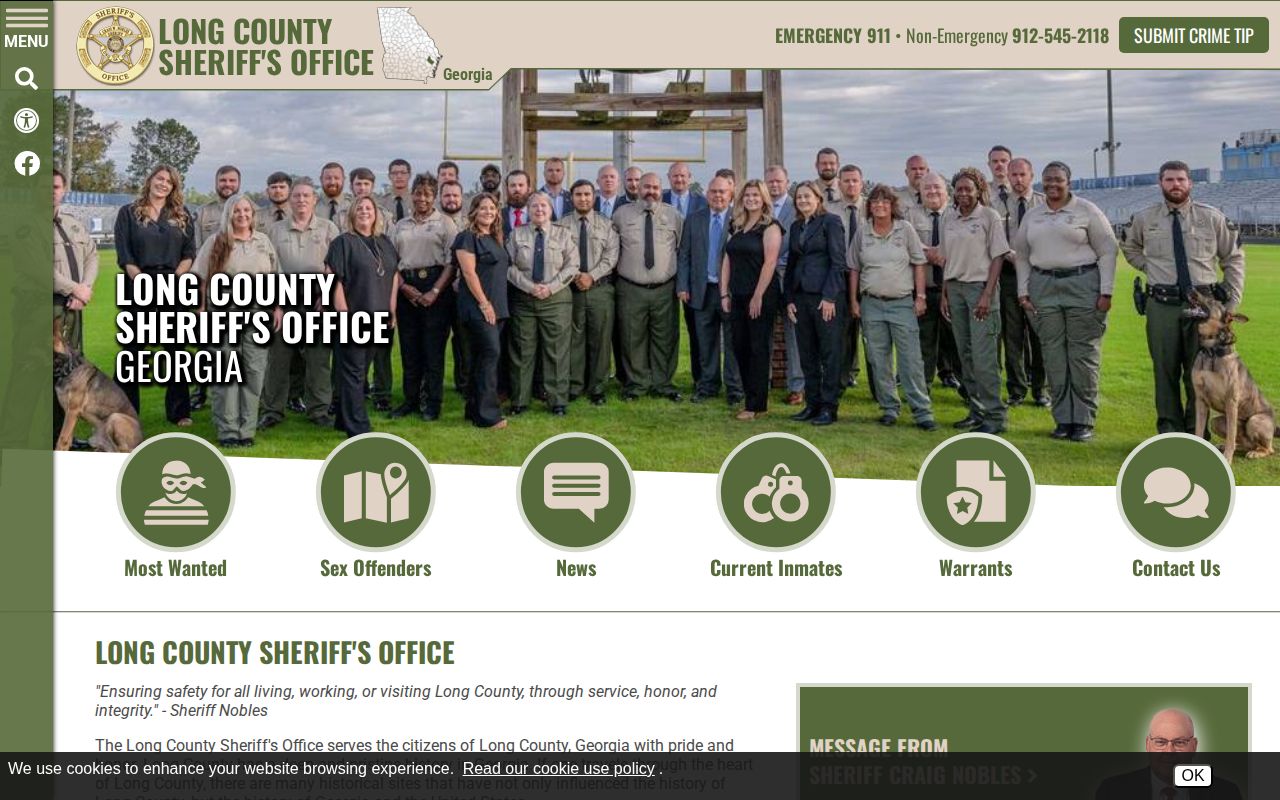
This capture is a navigation aid, not a list of people.
Where Long County Arrests Go
Two questions decide everything: which agency owns the hold, and which jail has the person? The LCSO jail and bonding page states plainly that the sheriff operates no jail. It names Tattnall, Wayne, Appling, McIntosh, and Screven county jails as receiving facilities. Every Long County hold still runs through LCSO. A hold is simply an agency's legal request to keep someone locked up. Housing someone elsewhere never hands off ownership of the Long report, warrant, or charge record.
Call LCSO at 912-545-2118 and ask where the person sits today. Then verify with that jail directly. Trust the current dedicated housing page over any older official page listing different facilities. Write down the date of each answer. Transfers make stale results out of correct ones. A receiving jail's row says nothing about court outcomes. The official housing page documents this unusual arrangement.
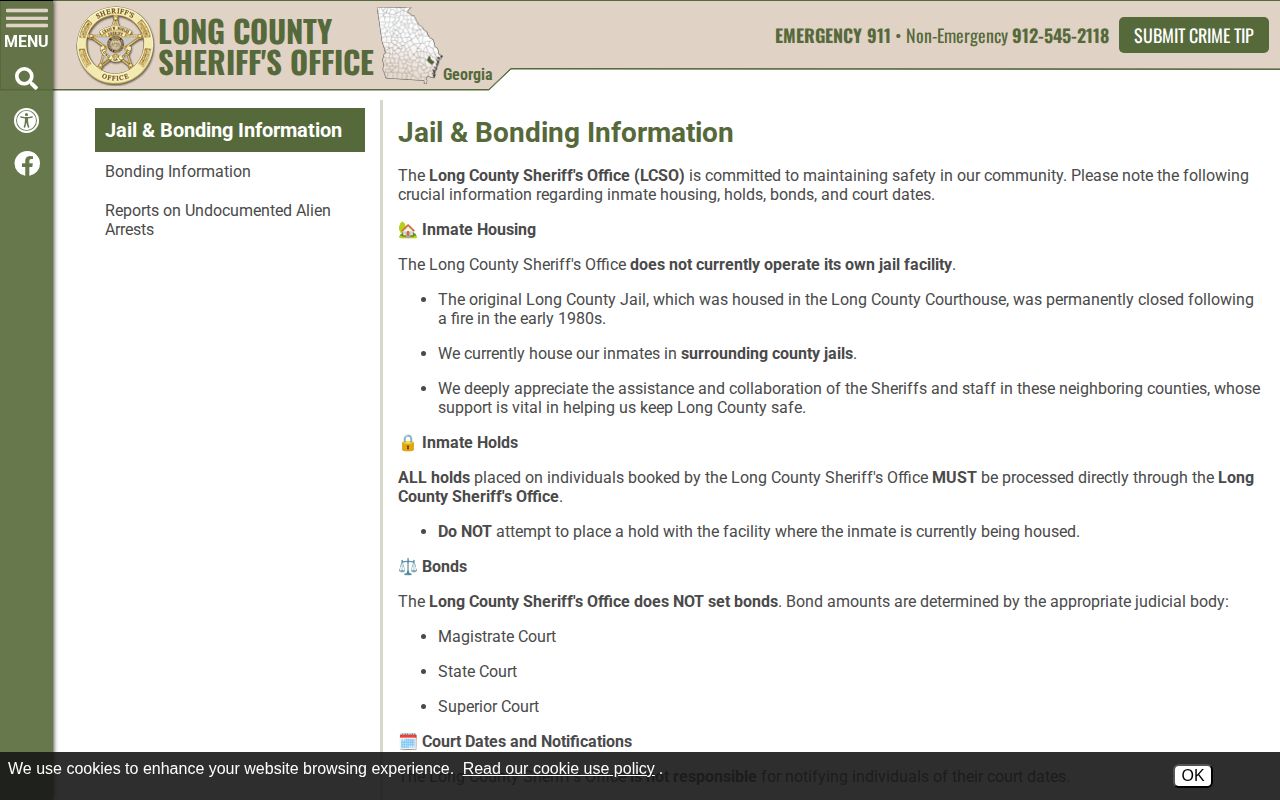
A listed facility is a lead. Verify it before relying on it.
Search Long County Arrest Custody
LCSO posts its custody list as Interop Web, labeled Current Inmates. The portal sometimes fails with an ASP.NET database-login error. That glitch is not closure. If it loads, note the time. If not, call LCSO and work the receiving-jail route.
| Roster field | Meaning and limit |
|---|---|
| Name | Booked identity; compare another identifier. |
| Booking date/number | Intake event and local key, not conviction. |
| Charge | Charge that may change in court. |
| Bond | Court-set release condition. |
| Housing/status | Facility and custody state at that time. |
| Photo | No official Long photo feed was verified. |
- Open Current Inmates from the sheriff site.
- Search the exact name and compare an identifier.
- Note source, time, date, status, and facility.
- Call LCSO if access or housing is unclear.
- Use court records for disposition.
Bond After a Long Arrest
LCSO does not set bonds. Courts do. The sheriff's page lays out cash, property, and commercial bail-bond routes, and notes that no bonding company currently operates in Long County. It lists nearby firms without endorsing any. Out-of-county property requires approval. There is a $20 property-bond instruction, but confirm current rules before paying or driving anywhere.
Bond is a set of release conditions while the case proceeds. It is not a fine. The receiving jail may handle the paperwork while a Long County court steers the case. Ask where documents go, what ID is required, and whether another hold blocks release.
Where Long Arrest Records Appear
Start with official sources every time. News outlets and private indexes can surface leads, but Long County controls none of their depth, timing, or name matching.
| Channel | Type | Use |
|---|---|---|
| Current Inmates | Officially linked | Current custody |
| LCSO releases | Official | Selective news |
| Courts eAccess | Official | Case outcome |
| Coastal Courier | News | Story context |
| RecentlyBooked | Unofficial | Claimed 30-day lead |
| Mugshots.com | Unofficial | Possible old lead |
RecentlyBooked lists no Long arrests in its claimed window. That empty result is not an official zero. Busted Newspaper carries no Long section, and other aggregators offer no dependable local feed. Never merge profiles that share a name.
Ludowici Recent Arrests
Ludowici is the only incorporated city in the county. The official directory lists Ludowici Police at 912-545-2222. The city publishes no roster or daily blotter. A city arrest can still flow into the same distributed custody route. The Ludowici Recent Arrests page explains how to sort out the arresting agency from the custodian.
Long County Arrest Record Fields
A booking record documents the arrest itself. An arrest report describes the police event. A court docket tracks what follows. They overlap but never substitute for one another, so ask for the exact record and anchor it with a date, report number, booking number, or exact name.
| Field | Meaning |
|---|---|
| Name | Identity used at booking |
| Booking date/time | When intake occurred |
| Agency | Office tied to arrest |
| Charge/code | Accusation at that stage |
| Bond | Release condition |
| Housing/status | Custody location and state |
| Case number | Later court identifier |
Medical data, fingerprints, Social Security numbers, juvenile identifiers, and unrelated private details do not belong on a public page. Long retention never makes a field fit to publish.
Long Arrest Mugshots and Photos
Long County publishes no booking-photo feed. The sheriff's office does not run its own jail, so there is no county mugshot roster to browse. A private site may claim Long County withholds booking photos, but that claim decides nothing for the jails that actually hold Long arrestees. Want a photo? Ask the custodian of the record directly.
Booking photos are simply a picture taken at intake. There are no galleries or profile grids here. If an arrest leads to a state prison term, the Georgia Department of Corrections query can display a photo. That image belongs to a state prison record, though, not a fresh Long County arrest.
Request Long County Arrest Records
Long County arrest record requests start at the LCSO Records Request page. It splits the routes three ways: Local Records Only, GCIC history, and open-records requests. Local Records Only means just files LCSO keeps itself. It never covers a statewide history. No dedicated photo form, fixed photo fee, guaranteed turnaround, or records email is posted. Call 912-545-2118 before sending anything. Confirm the custodian, cost, format, and delivery.
- Name the existing arrest, booking, release, report, or photo record.
- Give a narrow date range, name, number, and known jail.
- Ask LCSO to identify another custodian if needed.
- Request lawful redactions and a fee estimate.
- Keep the response and check the court outcome.
The captured request page shows these routes.
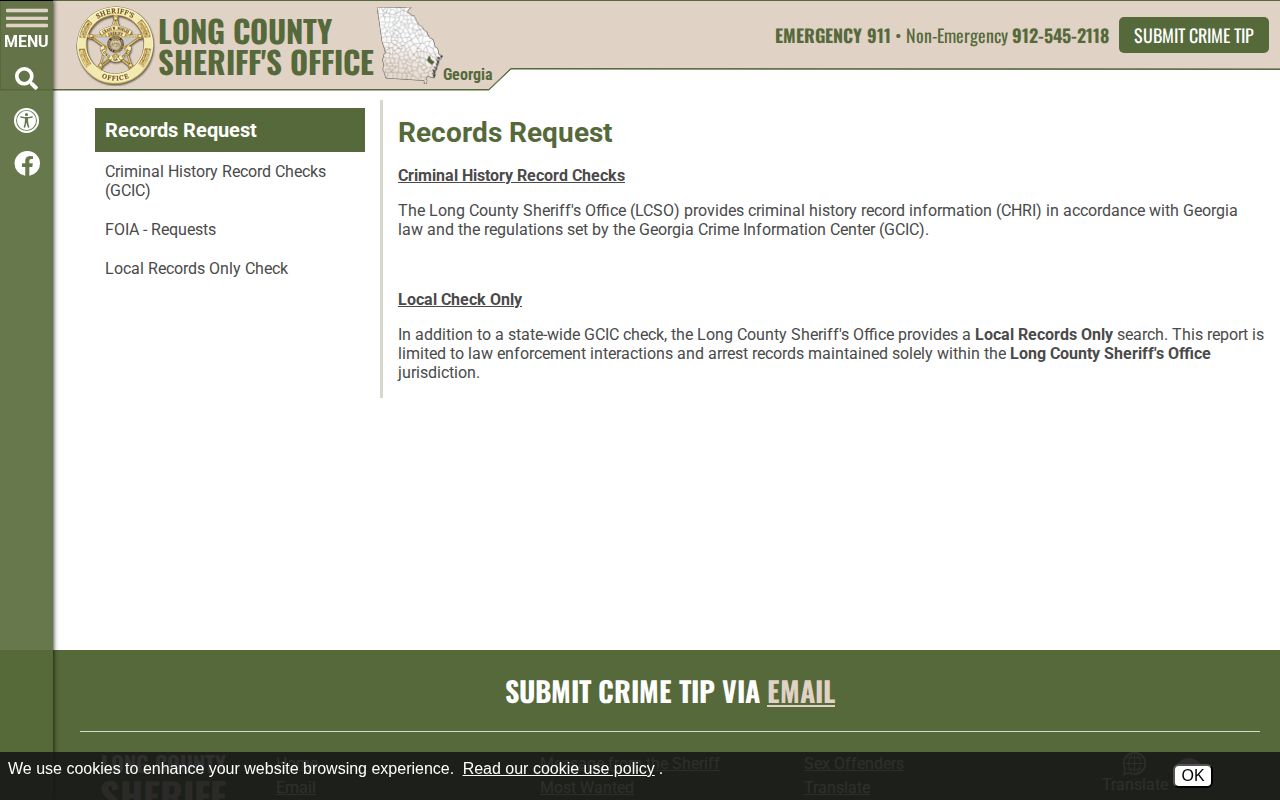
Select the route matching the record’s scope and custodian.
Georgia Arrest Records and Photos
Georgia law opens public records, yet exemptions, redaction, fees, and actual custody still shape what gets released. An initial report may leave out investigative material held while a case stays pending. Ask which exemption applies when something is withheld. O.C.G.A. § 35-1-19 regulates certain booking-photo requests and the commercial practices around them. The law does not build a permanent photo gallery.
Juvenile records stay confidential unless a lawful exception applies. Restricted, sealed, and expunged records need care too. Restriction limits access yet cannot erase every local or private copy. A missing result proves neither that no arrest occurred nor that an old private copy is current.
Long County Arrest Warrants
The LCSO Warrants page walks through a workflow rather than offering a searchable database. An applicant files an incident report first. Then it goes to Magistrate Court for a hearing. Once issued, LCSO records the warrant. Deputies enter GCIC or NCIC details when applicable. They assign the work and coordinate with other agencies. Transport may be arranged.
The Most Wanted page shows an unavailable-content notice. No names or count can be drawn from it. A Long County warrant may be served, recalled, or changed. Anyone who believes one applies should get lawful help. Talk to an attorney, a court, or LCSO instead of acting alone. Call 911 for an immediate threat.
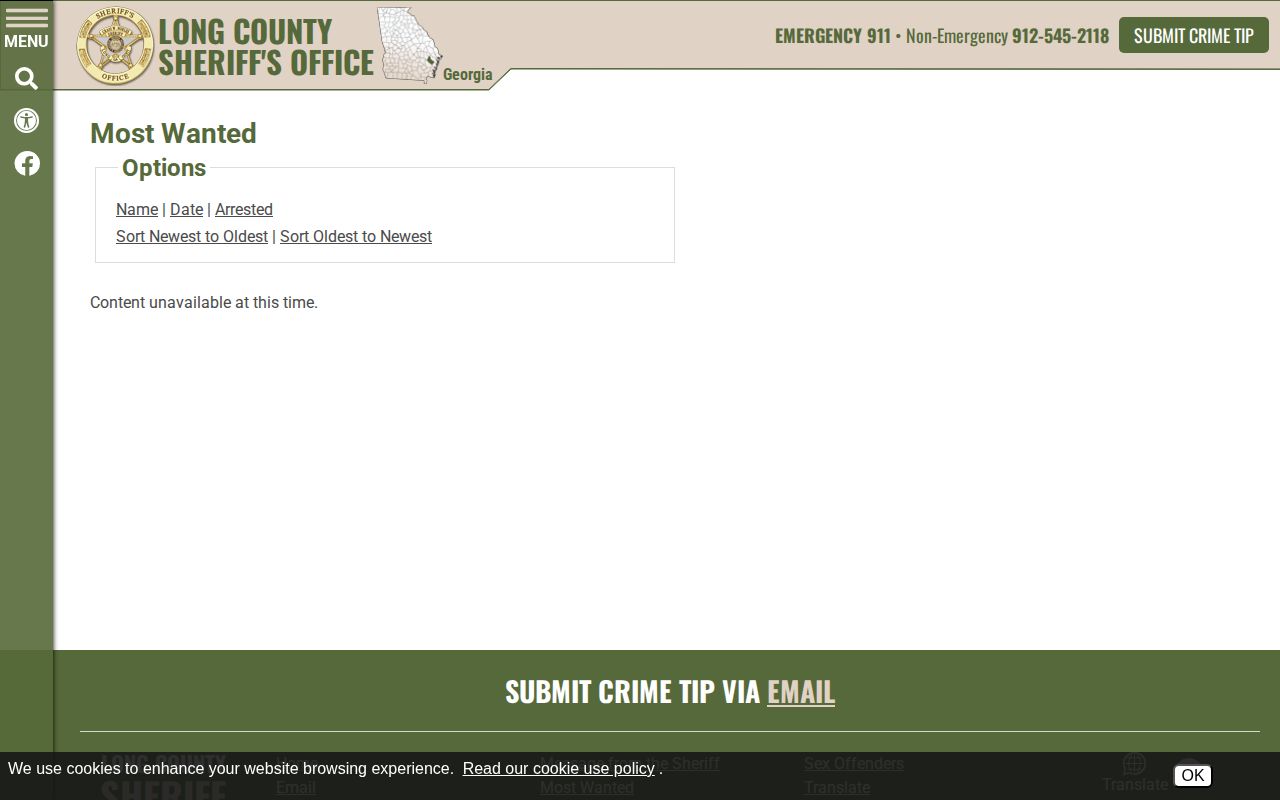
It is an availability record, not a list of people.
Long Arrests Reach Three Courts
Routing matters in Long County, and the court information page spells out which court does what. Magistrate handles warrants, preliminary matters, and some bail calls. State Court takes misdemeanors and traffic. Superior Court holds felonies and general jurisdiction. At arraignment the charges are formally presented; later, the disposition records the outcome. Use Georgia Courts eAccess for available Long State and Superior records, keeping in mind that booking charges can be amended, reduced, dismissed, or replaced.
Why Long Arrest Directories Conflict
A fire closed the original courthouse jail in the early 1980s. That history explains why old directories clash with current practice. Some listings still show a "Long County Jail" with outdated housing details. It proves nothing about who runs a jail today. GDC also lists a Long County Jail entry plus a separate Long Unit. For local operations the current LCSO jail page is stronger. Use GDC only for state correctional custody. Never treat it as a fresh booking roster.
Correcting Long Arrest Information
Start with the publisher. For LCSO errors, use its contact page or call 912-545-2118. Give the exact page, person, date, disputed text, and proof. Its form is not monitored around the clock, and plain email is insecure.
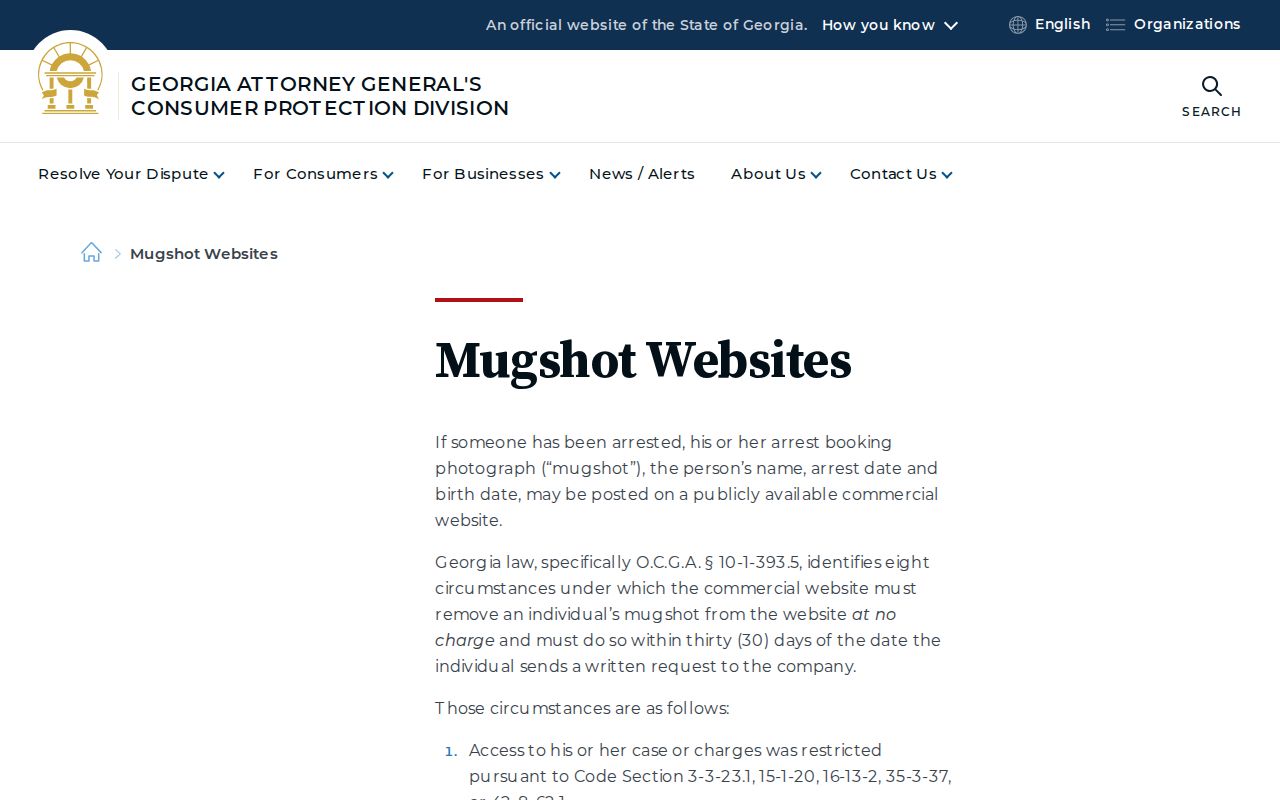
The Georgia Courts guidance warns that GCIC cannot control local or private copies. For qualifying commercial mugshot copies, the Attorney General guide describes free removal within 30 days after a qualifying written request and warns about removal fees. No paid service is endorsed.
The official consumer page shows this route.
Correct the source first, then refresh stale search results.
Custody Beyond Long County Arrests
The Georgia offender guide sends state-prison searches to GDC. County-jail questions go to the county. A match there means state custody, not a new local booking. The BOP locator covers federal inmates. The ICE locator uses separate identifiers and limits. Never infer immigration status or a federal hold from a local arrest or a no-match. For transfer alerts, the VINELink Check is the tool, though each receiving jail's participation varies.
Long Arrest Records Over Time
Retention and access are different things. Georgia Archives schedules set how long agencies should keep each record series, but they do not promise equal online access. Daily incarceration lists carry a one-year schedule. Jail booking records and registers last ten years after release or the last entry. Holding-cell video gets just 180 days. Retention governs records management. It never requires a roster website to display a year of names or makes protected booking fields fit to publish.
Split custody makes the custodian question vital. LCSO may hold the report or warrant while a receiving county keeps booking and release records. Name the date, person, agency, report number, and known jail in any request. Ask LCSO to identify the custodian. If a receiving jail created its own record, request it there. Georgia Archives says most county records stay local, so it is not the first source for a recent booking.
The historic Long County newspaper collection suits old notices, not live custody. Search caches are weak proof. An old row can preserve a stale jail address. Keep the source URL and access date, then confirm with the custodian.
News About Long County Arrests
Local news can add useful context to a booking record, but it never replaces one. Coastal Courier runs public-safety coverage for the area. Long County Press puts out a weekly paper for the county. Its pages carry no full arrest blotter. WTOC and WJCL report on individual incidents as events unfold. One caution applies to dates. A story's publish date rarely matches the actual arrest time, and reporters work with the facts known at filing, so details can shift as a Long County case moves ahead. The Long County Press latest news page shows what this channel offers.

It is selective news, not a complete booking feed.
How to Read Arrest Results
Empty results happen for many reasons. The person may be out on release or moved to another jail. The name may sit under a different spelling. State law can also shield a record. A service outage hides entries too. None of that means no arrest happened. Treat a name match as a lead only, since identifiers, booking date, agency, and court case must all line up.
Each tool measures something different. A roster is just a custody snapshot. A booking record documents the arrest itself. Press releases pick and choose. A warrant authorizes an arrest, not a booking. A docket tracks court events, and the disposition gives the outcome. VINELink sends custody alerts, not photos, while GDC, BOP, and ICE each cover only their own systems.
Why do people vanish from a roster? Most rosters show who is in custody now, not every past booking. Bond release, a transfer to state custody, a spelling mismatch, or a slow update can all explain the gap. Ask LCSO about the hold and where the person is housed. Then check with that receiving jail, and use the official VINE route for alerts once you have matched the right person and facility.
Does a booking charge equal the final case? No, it reflects the charge logged at booking. Prosecutors can amend or drop charges, and courts reach their own results. Follow the Long County court route and Georgia Courts eAccess for the disposition, and ask the clerk when a public result is missing.
Keep the source, URL, access date, and status with anything you save, and recheck changing custody details with the office that owns them. Remember one Long County quirk: LCSO may hold the warrant while another county houses the person. Skip saving sensitive identity fields just to document a search.